
Enhanced RAG
Advanced Retrieval-Augmented Generation system with multi-stage retrieval, re-ranking, and query decomposition for enterprise conversational AI.
Challenge
Enterprise conversational AI systems struggle with hallucination, outdated knowledge, and inability to reason over large proprietary corpora in real time.
Approach
- Multi-stage RAG-Fusion pipeline with parallel query generation and reciprocal rank fusion (RRF) for robust document retrieval
- Dense retrieval with FAISS indexing over million-scale document collections
- Contrastive learning with Momentum Contrast (MoCo) for domain-adaptive embedding fine-tuning
- Domain-Adaptive Pretraining (DAPT) and in-context learning for specialized verticals
Results
- Significant improvement in factual grounding and answer relevance across enterprise benchmarks
- Sub-second retrieval latency at million-document scale
- Reduced hallucination rate through multi-hop evidence aggregation
Impact
Core architecture powering the Amazon Q Chat Engine, serving millions of enterprise users with accurate, grounded conversational AI.
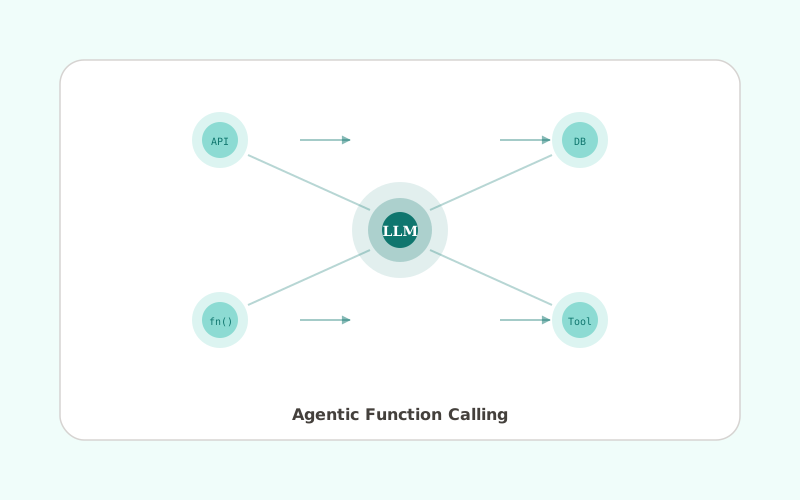
Agentic Function Calling & Tool Orchestration
Multi-step agentic reasoning framework with structured function calling, tree-of-thought planning, and constrained decoding for enterprise tool orchestration.
Challenge
Enterprise LLMs must decompose complex user requests into sequences of API calls, database queries, and tool invocations — maintaining coherence across multi-hop reasoning chains while handling errors gracefully and respecting authorization boundaries.
Approach
- Structured function-calling framework with JSON schema validation and type-safe tool definitions supporting parallel and sequential execution
- ReAct-style iterative reasoning with tree-of-thought planning for multi-step task decomposition and dependency graph construction
- Constrained decoding via grammar-guided generation (GCD) for guaranteed schema adherence and valid structured outputs
- Fine-tuned function-calling models using synthetic trajectory generation and DPO on execution feedback signals — learning from whether tool calls succeed, not just human preference
Results
- Significant improvement in multi-step task completion rate over chain-of-thought baselines
- Near-perfect schema adherence via constrained generation, eliminating malformed tool calls
- Robust error recovery and autonomous re-planning when tool calls fail mid-chain
Impact
Core orchestration layer for enterprise agentic AI, enabling complex multi-tool workflows with reliable structured outputs across diverse enterprise knowledge sources and APIs.
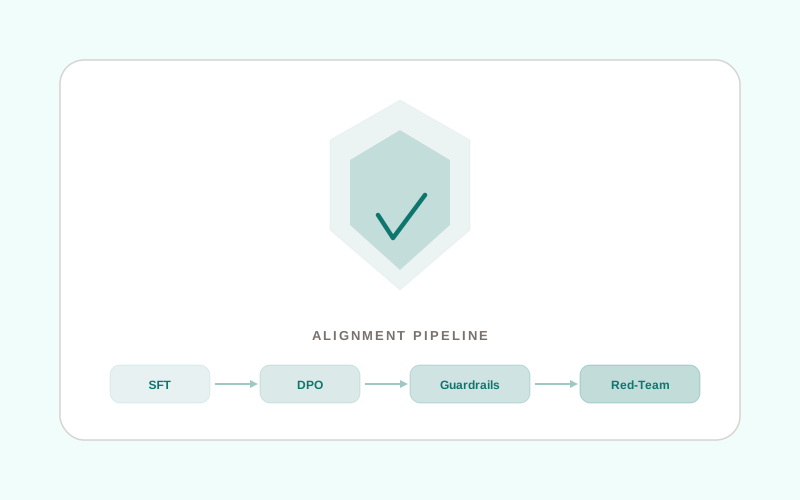
LLM Post-Training Alignment & Safety
End-to-end alignment pipeline combining DPO/KTO preference optimization, constitutional AI guardrails, automated red-teaming, and PII-aware decoding for enterprise LLM deployment.
Challenge
Deploying LLMs in enterprise environments demands rigorous alignment — balancing helpfulness with safety, preventing PII leakage, mitigating hallucination, and ensuring compliance with enterprise policies — where a single violation can have serious consequences.
Approach
- Multi-stage post-training pipeline: supervised fine-tuning → DPO/KTO preference optimization → constitutional AI filtering, eliminating the reward model bottleneck of classical RLHF
- Automated red-teaming infrastructure with adversarial prompt generation, gradient-based attack simulation, and jailbreak taxonomy coverage analysis
- PII-aware decoding with named entity recognition guardrails and real-time output sanitization layers
- Reward model ensembles with uncertainty quantification for calibrated refusal — the model knows when it doesn't know
Results
- Significant reduction in policy violations while maintaining task performance on enterprise benchmarks
- Near-zero PII leakage rate across enterprise deployment surfaces
- Scalable red-teaming pipeline generating diverse adversarial test cases at thousands per hour
Impact
Safety and alignment infrastructure for trusted enterprise LLM deployment, ensuring compliant and reliable AI interactions at scale across regulated industries.
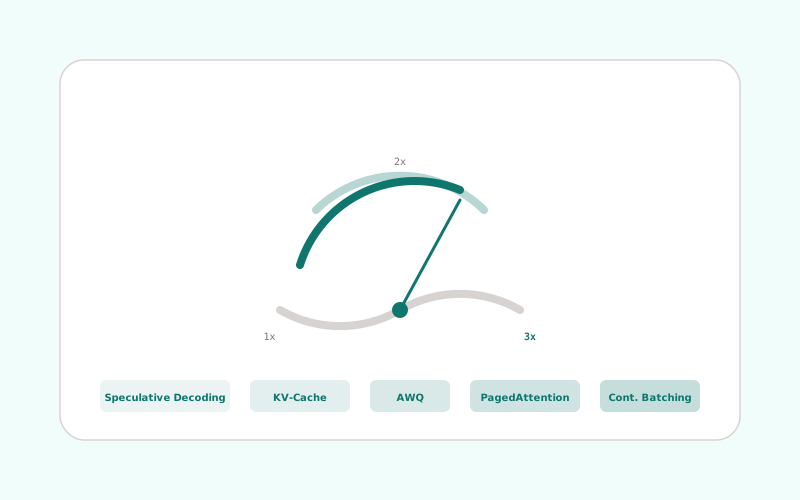
Efficient LLM Serving & Speculative Decoding
Production LLM serving stack combining speculative decoding, KV-cache compression, quantization-aware fine-tuning, and continuous batching for enterprise-scale inference.
Challenge
Serving large language models at enterprise scale demands sub-second latency, high throughput, and cost efficiency — while preserving output quality across diverse concurrent workloads.
Approach
- Speculative decoding with a distilled draft model — small model proposes token sequences, large model verifies in parallel, improving throughput with mathematically identical outputs
- KV-cache compression with grouped-query attention (GQA) and sliding window strategies for long-context serving without linear memory growth
- Quantization-aware fine-tuning (AWQ/GPTQ) with task-specific calibration sets for INT4 deployment with minimal quality degradation
- Dynamic continuous batching with PagedAttention for GPU memory management, maximizing hardware utilization across heterogeneous request lengths
Results
- Significant inference throughput improvement via speculative decoding with mathematically identical outputs
- Substantial memory reduction through KV-cache compression, enabling longer context windows on existing hardware
- Production INT4 quantization with minimal quality degradation on task-specific benchmarks
Impact
Powers high-throughput, low-latency LLM serving infrastructure for enterprise-scale deployment, reducing inference cost while maintaining quality guarantees.
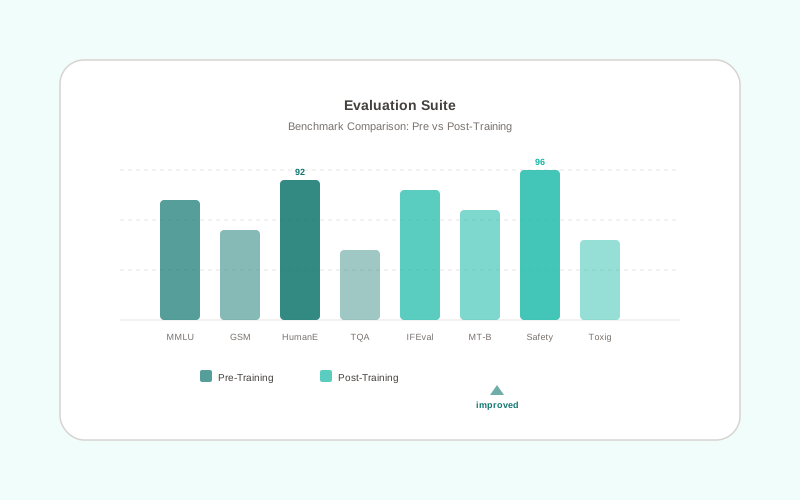
LLM Evaluation & Post-Training Optimization
Comprehensive evaluation infrastructure and post-training optimization suite for measuring, diagnosing, and improving LLM capabilities across reasoning, instruction following, safety, and enterprise task completion.
Challenge
Post-training gains are invisible without rigorous, multi-dimensional evaluation. Standard benchmarks miss critical enterprise failure modes — instruction adherence, multi-turn consistency, tool-use accuracy, and safety regressions — making it impossible to iterate confidently on SFT, DPO, or distillation without a purpose-built eval harness.
Approach
- Built a modular evaluation suite spanning 12+ benchmark dimensions: MMLU, GSM8K, HumanEval, IFEval, MT-Bench, TruthfulQA, safety, toxicity, function-calling accuracy, and custom enterprise task sets
- Automated pre vs. post-training regression testing — every SFT/DPO checkpoint evaluated in CI and compared against baseline with statistical significance tests
- LLM-as-judge pipelines with calibrated rubrics for open-ended generation quality, factual grounding, and instruction adherence scoring
- Eval-driven feedback loop: diagnosis from benchmark results → targeted training data curation → model retraining → re-evaluation, enabling data-driven quality iteration
Results
- Measurable improvements across post-training benchmarks through eval-driven iteration cycles
- Identified safety regressions pre-deployment that standard benchmarks missed
- Accelerated post-training iteration cycles through automated evaluation and targeted data curation
Impact
Core evaluation infrastructure driving post-training decisions for enterprise LLM deployment — every model checkpoint is evaluated, compared, and promoted through a data-driven pipeline, ensuring measurable quality gains at each iteration.

Semantic Segmentation for AR/VR
High-accuracy semantic segmentation for AR/VR eye tracking using SWIN Vision Transformers with knowledge distillation for on-device deployment.
Challenge
AR/VR devices require pixel-precise eye region segmentation at real-time speeds on power-constrained hardware, with robustness to extreme lighting and motion.
Approach
- SWIN Vision Transformer backbone with UperNet decoder for multi-scale feature fusion
- Knowledge distillation from large teacher to compact student model
- Quantization-aware training (QAT) for INT8 on-device inference
- Adversarial domain adaptation with diffusion-based augmentation for distribution shift
- Active learning pipeline with weak supervision for efficient annotation
Results
- State-of-the-art mIoU on internal AR/VR eye segmentation benchmark
- Significant inference speedup through distillation + quantization for on-device deployment
- Robust to cross-device and cross-user distribution shifts
Impact
Deployed in Meta Reality Labs AR/VR pipeline, enabling precise gaze tracking and foveated rendering for next-generation headsets.
MultiModal Knowledge Transfer
Cross-modal knowledge transfer framework using CLIP and Vision Transformers for zero-shot Visual Question Answering and Image Captioning.
Challenge
Bridging vision and language modalities for VQA and captioning requires massive paired datasets. Enabling zero-shot transfer to new domains without task-specific fine-tuning remains an open problem.
Approach
- CLIP-based vision-language alignment with cross-attention fusion layers
- Contrastive learning objectives for joint embedding space optimization
- Masked language modeling + pseudo-labeling for self-training on unlabeled data
- Distributed training across multi-GPU clusters for billion-parameter models
Results
- Zero-shot generalization to unseen visual domains and question types
- Competitive with supervised baselines using 10x less labeled data
- Scalable to billion-parameter models with linear training efficiency
Impact
Framework adopted across Meta product surfaces for visual understanding tasks, reducing annotation cost and enabling rapid domain expansion.

Low-Resource LLMs
Cross-lingual language understanding using self-supervised transformers for underrepresented languages with minimal labeled data.
Challenge
Most NLP advances concentrate on high-resource languages. Extending LLM capabilities to hundreds of low-resource languages requires novel transfer learning and data augmentation strategies.
Approach
- Multilingual pre-training with mBERT and XLM-R on cross-lingual corpora
- Cross-lingual alignment via adversarial training on shared embedding spaces
- Back-translation augmentation to synthetically expand low-resource training data
- Masked language modeling (MLM) fine-tuning with language-adaptive layers
Results
- Strong performance gains on NER, classification, and QA tasks for low-resource languages
- Effective zero-shot cross-lingual transfer from high-resource to unseen languages
Impact
Enables language understanding for underrepresented populations, supporting equitable AI deployment across global markets.

Cancer Detection
AI-driven pathology analysis system for tumor detection and localization using hierarchical CNNs and self-supervised learning on whole-slide images.
Challenge
Manual pathology review is slow and error-prone. Whole-slide images are gigapixel-scale, requiring architectures that handle extreme resolution while maintaining fine-grained localization.
Approach
- Hierarchical CNN with attention mechanisms for multi-scale feature extraction from gigapixel slides
- Self-supervised pre-training on unlabeled pathology images to learn robust histological representations
- Transfer learning from ImageNet with progressive fine-tuning
- End-to-end deployment on AWS SageMaker with Lambda-based inference API
Results
- High sensitivity and specificity for tumor detection on clinical datasets
- Precise tumor localization with attention-guided heatmaps
- Scalable to clinical throughput on cloud infrastructure
Impact
Accelerates pathology workflows and provides decision support for clinicians, reducing diagnostic turnaround time.

Disease Prediction
Adversarial AI and causal inference framework for unbiased disease prediction, combining GANs with Double ML for robust diagnostic models.
Challenge
Clinical prediction models inherit biases from training data — demographic, socioeconomic, and selection biases — leading to disparate outcomes across patient populations.
Approach
- Adversarial learning to decorrelate predictions from sensitive attributes
- Double ML framework for causal effect estimation under confounding
- VQ-VAE and GAN-based synthetic data augmentation for minority groups
- Clustering-based patient stratification for personalized risk scoring
Results
- Measurable reduction in prediction disparity across demographic groups
- Maintained clinical accuracy while improving fairness metrics
- Robust causal estimates under confounding scenarios
Impact
Advances equitable healthcare AI by ensuring diagnostic models perform fairly across all patient populations.

Synthetic Data Generation
Privacy-preserving synthetic medical data using diffusion models and convolutional GANs with formal differential privacy guarantees.
Challenge
Healthcare AI research is bottlenecked by data access — patient privacy regulations (HIPAA) prevent sharing real medical records, limiting model development and reproducibility.
Approach
- Convolutional GAN architecture with differential privacy (DP-SGD) for formal privacy guarantees
- Diffusion model pipelines with controlled noise scheduling for high-fidelity generation
- Privacy auditing via membership inference attacks to validate protection
- Statistical fidelity metrics ensuring synthetic data preserves clinical distributions
Results
- Synthetic data passes privacy audits while maintaining downstream model utility
- Published in Information Sciences (140+ citations)
- Enables HIPAA-compliant data sharing for multi-site research
Impact
Unlocks healthcare AI research by providing shareable, privacy-safe synthetic datasets — cited 140+ times and adopted by research groups globally.
Deep Sequence Recommender
Production recommender system using Transformer-XL and meta-learning for temporal-aware personalization at billion-user scale.
Challenge
User preferences evolve over time and new users lack interaction history. Traditional collaborative filtering fails to capture temporal dynamics and suffers from cold-start problems.
Approach
- Transformer-XL architecture for long-range sequential dependency modeling
- Model-Agnostic Meta-Learning (MAML) for few-shot cold-start user adaptation
- NLP-enriched item representations using BERT and contextual embeddings
- Production deployment with ONNX/TensorRT optimization and Kubernetes orchestration
Results
- Improvement in recommendation relevance metrics over production baseline
- Effective cold-start handling with meta-learned user priors
- Sub-100ms inference latency at billion-scale with optimized serving
Impact
Deployed in Meta's production recommendation surfaces, directly impacting user engagement and content discovery at scale.